

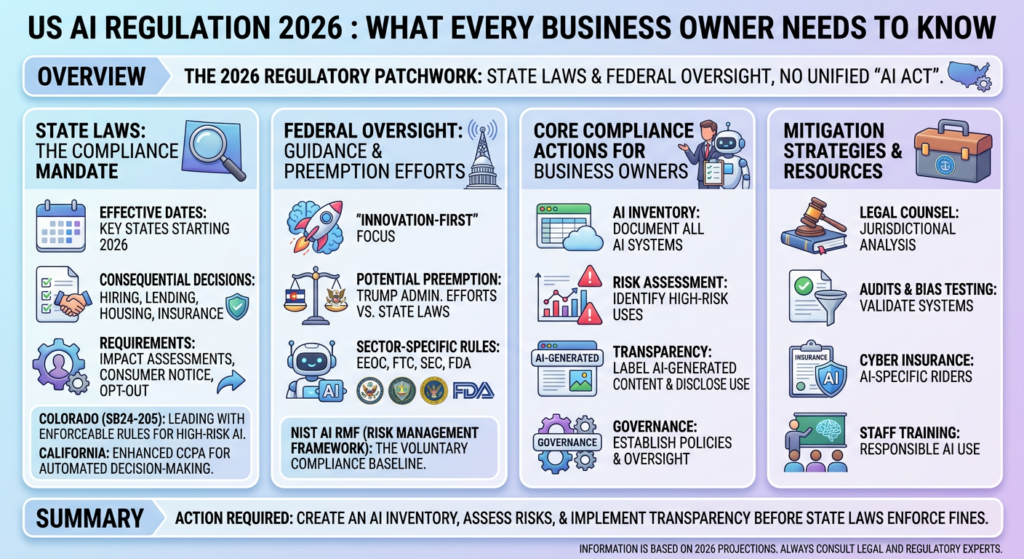
The “Wild West” era of Artificial Intelligence is officially over. As we move through 2026, the United States has transitioned from vague ethical guidelines to a strict, enforceable legal framework. For businesses using AI for marketing, automation, or data analysis, compliance is no longer a choice—it is a mandatory pillar of your operational strategy.
If you are running a business in the US market, this guide breaks down every legal hurdle you must clear to avoid massive fines and de-platforming.
1. The Federal AI Transparency & Accountability Act (FATAA)
The cornerstone of 2026 legislation is the FATAA. This law targets “Black Box” algorithms. If your AI makes a decision that affects a customer, you must be able to explain how.
Mandatory Disclosure and Watermarking
Every piece of synthetic media—be it an AI-generated blog post on your site, a promotional video, or a generated image—must now carry a digital signature.
- C2PA Standard: All visual assets must contain metadata proving they are AI-generated.
- The “Bot” Disclosure: If a customer interacts with your AI Sales Agent, a clear disclaimer must appear within the first 3 seconds of the interaction.
2. Algorithmic Bias and Consumer Protection
The Federal Trade Commission (FTC) has been granted new powers in 2026 to audit private AI models for bias.
- Liability: Your company is legally responsible for the output of your agents. If GPT-5 generates a defamatory statement or a discriminatory credit offer, the liability sits with you, not OpenAI.
- The Audit Requirement: For businesses with over $1M in revenue using AI for decision-making, a yearly “Bias Audit” is now required by law to ensure fair treatment across all demographics.
3. The New Data Sovereignty Standard
Data privacy has evolved. 2026 marks the death of the “Unlimited Training” era.
- Zero-Retention Mandates: When using APIs like Claude 4 for sensitive client data, businesses must use “Enterprise Tunnels” that guarantee data is wiped after the session and never used for retraining.
- Informed Consent 2.0: Simple “Accept Cookies” banners are gone. You now need explicit “AI Data Processing” consent from US users before their interactions can be fed into your fine-tuning pipelines.
4. Operational Impact: The “Human-in-the-Loop” Requirement
Google’s search algorithms in 2026 have been updated to align with these federal laws. Purely automated content is now flagged as “Low-Quality/Non-Compliant.”
- E-E-A-T & Verification: To rank on page 1, your articles must include a “Human Verification Statement.” This proves that a subject matter expert has audited the AI’s claims.
- The Role of the AI Compliance Officer: Even for small agencies, having a designated person responsible for AI safety is becoming the new standard in the US tech ecosystem.
5. Fines and Enforcement: What’s at Stake?
The 2026 regulations come with teeth. The “AI Safety Office” (AISO) can issue penalties that mirror GDPR-level fines:
- Minor Violations: (e.g., missing watermarks) can cost up to $50,000 per instance.
- Major Breaches: (e.g., unauthorized data scraping or biased decision-making) can result in fines up to 4% of global annual turnover.
6. Practical Steps for Compliance on Aiseful.com
To ensure your blog and your tools stay ahead of the curve, follow these three steps immediately:
Label your Content: Use a “Verified by Human” badge on every article to signal both to Google and your readers that your AI-assisted content is reliable.
Audit your Stack: Ensure every tool you use (Zapier, Make, OpenAI, Anthropic) is “2026 Compliance Certified.”
Update your Terms of Service: Explicitly state how you use AI to process user data and offer an easy “Opt-out” for data training.
Label your Content: Use a “Verified by Human” badge on every article to signal both to Google and your readers that your AI-assisted content is reliable.
7. Penalty Matrix: The Cost of Non-Compliance in 2026
To give you a clear picture of the risks, here is a breakdown of the current enforcement actions as defined by the AI Safety Office (AISO). These figures represent the baseline for first-time offenders.
| Violation Type | Specific Example | Estimated Fine (USD) |
| Transparency Breach | Failing to disclose AI-generated content or missing C2PA watermarks. | $10,000 – $50,000 per violation |
| Data Privacy Negligence | Using non-compliant APIs (retention-enabled) for sensitive US customer data. | $100,000 – $250,000 |
| Unchecked Algorithmic Bias | Deploying an autonomous sales agent that discriminates against protected groups. | Up to 4% of Global Annual Revenue |
| Identity Fraud | Creating “Deepfake” personas for marketing without explicit likeness rights. | $500,000 + Potential Criminal Charges |
8. FAQ: Navigating the 2026 AI Regulatory Landscape
Q: Does this law apply to me if my business is located outside the US?
A: Yes. If you have customers located within the United States, you must comply with the Federal AI Privacy Standard, regardless of where your servers are hosted.
Q: Will Google penalize me for using AI to write my blog?
A: Not for using AI, but for using unverified AI. Google’s 2026 update prioritizes “Human-Verified” content. Use a disclosure badge to protect your rankings.
Q: Is ChatGPT-5 compliant with these new laws?
A: Standard versions are not always compliant for sensitive data. You must use the “Enterprise” or “API” tiers with specific privacy configurations to meet US Federal standards.
Conclusion: Turning Regulation into Reputation
While these laws might seem restrictive, they are actually a gift to high-quality creators. By being transparent and compliant, you build a level of trust that “spam” competitors cannot match. In 2026, the most successful AI businesses are not just the fastest—they are the most trustworthy.
