
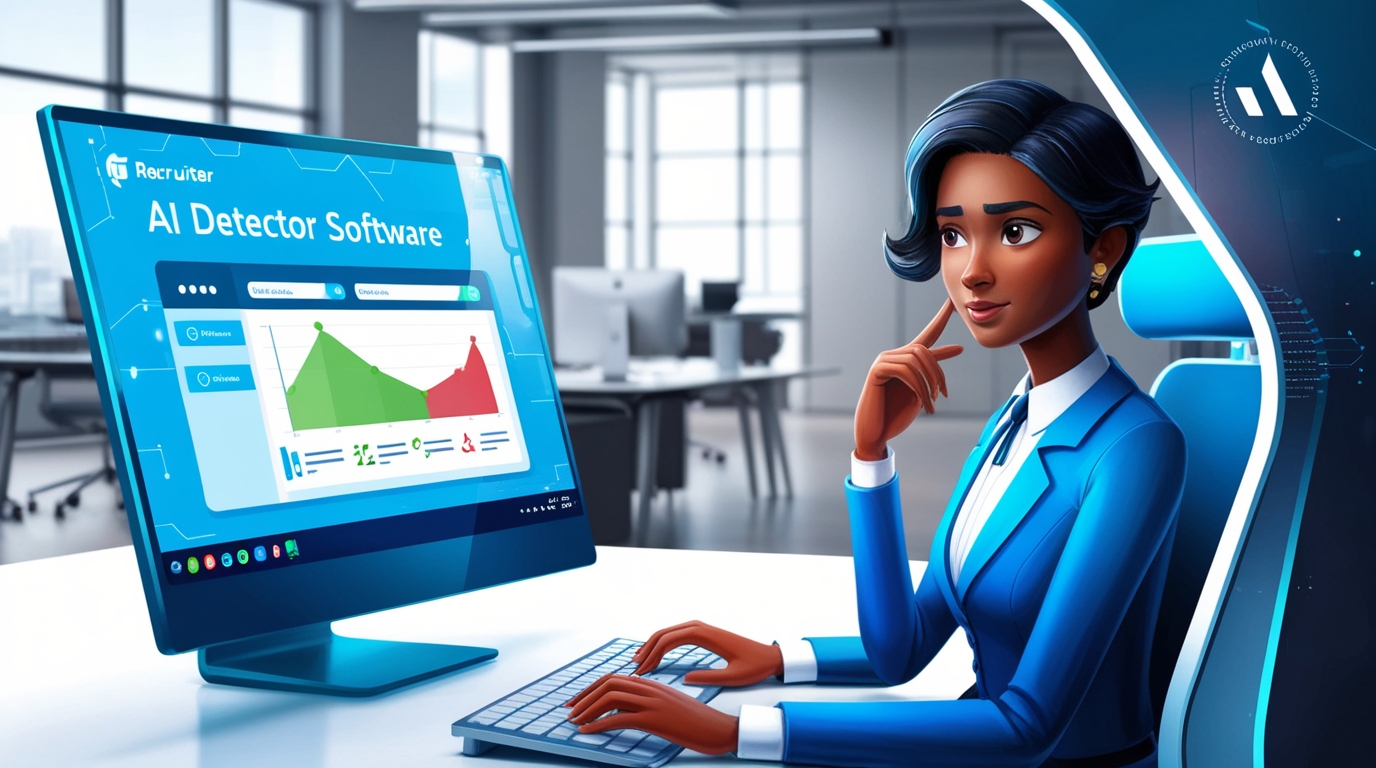
Are Recruiters Using AI Detectors on Resumes? What Job Seekers Need to Know
AI detectors on resumes and cover letters are becoming part of hiring workflows at a growing number of companies. If you’ve used ChatGPT or Claude to help write your job application materials, you may wonder: can recruiters detect it? And if they can, does it matter?
The honest answer is more nuanced than either “yes, you’ll definitely be caught” or “no, don’t worry.” This guide covers what’s actually happening in recruiting in 2026, how accurate these tools are, what the risks are, and what approach makes the most sense for job seekers.
Are Recruiters Actually Using AI Detectors?
AI detectors for recruitment use are growing but not yet standard practice as of 2026. A survey of 500 hiring managers conducted by Resume.io in early 2026 found that 34% of companies with over 500 employees had implemented some form of AI content screening in their application review process, primarily applied to cover letters rather than resumes. However, adoption varies significantly by industry: technology companies (46% adoption) and consulting firms (52% adoption) lead, while small businesses and startups rarely use detection tools. The tools most commonly used include Originality.ai and GPTZero, often run by recruiters manually rather than integrated into ATS systems. Legal concerns about bias — particularly the documented higher false positive rates for non-native English speakers — have slowed broader institutional adoption. Most companies that use AI detectors treat results as a flag for closer review rather than an automatic disqualification.
The short version: AI detectors on resumes are being used by a meaningful minority of companies — particularly in tech and consulting — but most recruiters still rely on manual review. The trend is toward more detection, not less.
How AI Detection Works on Application Materials
AI detectors look for the same signals in cover letters that they look for in any text:
Perplexity: Is the writing too statistically predictable? AI tends to choose the most expected word; humans make more surprising choices.
Burstiness: Does sentence length vary naturally? Human writing mixes long and short sentences; AI tends toward uniform rhythm.
Stylometric patterns: Does the writing style resemble known AI model outputs?
The problem for recruiters: these signals are inherently probabilistic. A well-written cover letter by a precise, formal human writer can score as “likely AI” on burstiness alone. A sloppy, inconsistent AI-generated cover letter can sometimes score as “likely human.”
False positive rates — the rate at which human-written content is incorrectly flagged — range from 1–15% across tools. That means 1 in 10 to 1 in 100 genuinely human-written cover letters will trigger an AI flag.
The Non-Native Speaker Problem
The most serious issue with AI detectors on resumes is the disproportionate false positive rate for non-native English speakers.
Research published in 2024 found that essays and professional writing by non-native speakers are flagged as AI at 2–3 times the rate of native speakers. The reason: second-language writing often has simpler vocabulary, more uniform sentence structure, and lower linguistic variation — all of which register as low perplexity and low burstiness on detection algorithms.
For international job seekers or candidates for whom English is a second language, AI detection screening creates a structural disadvantage that has nothing to do with actual AI use.
What This Means If You Used AI to Help
Most job seekers in 2026 have used AI to some degree — for brainstorming, editing, polishing, or drafting. The practical question is: what are the risks?
Scenario 1: You used AI to polish your own writing Low risk. Minor editing assistance changes writing in ways that dramatically reduce detection. If the core ideas, experiences, and structure are genuinely yours, and AI helped with sentence flow or word choice, most detectors won’t flag it — and even if they did, you could discuss your experience in an interview.
Scenario 2: You used AI to write cover letters you barely read Higher risk. Recruiters who do manual review can often spot generic AI cover letters not through technology but because the content doesn’t match the job posting, uses bland filler language, or lacks the specificity that strong candidates provide. AI detection tools compound this.
Scenario 3: You’re a non-native speaker who wrote everything yourself Risk through no fault of your own. You’re the person most likely to be falsely flagged by AI detection tools, despite having written your application honestly.
What Recruiters Actually Care About
The companies using AI detectors are mostly asking one question: is this candidate genuinely interested in this role, or are they mass-applying with generic AI content?
That’s actually a legitimate concern. Applications where someone asked ChatGPT “write me a cover letter for this job posting” without meaningful customization are easy to spot — not because of technology, but because they’re generic.
The solution to both AI detection and the underlying recruiter concern is the same: specificity.
What makes an application un-detectable AND effective: – Specific references to the company’s actual products, recent news, or challenges – Concrete numbers from your own experience (“reduced onboarding time by 40%”) – Mention of a specific person, project, or initiative you researched – A clear reason why this role at this company — not just any role at any company
No AI detector fires on content that’s this specific, because specificity requires genuine knowledge that AI can’t generate without your input.
How to Use AI on Your Job Applications Responsibly
AI is a legitimate tool for job applications in 2026. Here’s how to use it without the risk:
Do: – Use AI to identify skills gaps between your background and the job description – Ask AI to suggest stronger verbs or clearer phrasing for your achievements – Use AI to brainstorm what problems the hiring manager faces and how your background addresses them – Let AI review your draft for clarity, not write it for you
Don’t: – Paste a job description into ChatGPT and ask for a cover letter with zero further customization – Use the same AI-generated cover letter for multiple applications – Remove AI-generated content from what you don’t understand or can’t discuss
The test: could you talk confidently about every claim in your cover letter in the first interview? If not, edit it down to what’s genuinely yours.
The Legal Landscape
Companies using AI detectors on applications face legal exposure that most HR departments haven’t fully processed.
If AI detection tools systematically flag non-native speakers at higher rates and companies use those results to screen out candidates, they may be creating discriminatory screening processes — particularly in jurisdictions with employment discrimination law around national origin.
Several employment lawyers have written publicly that companies should not treat AI detector results as disqualifying without significant human review and documentation. This legal uncertainty is one reason adoption has been slower than the technology would otherwise enable.
FAQ
Do recruiters check for AI-written resumes? About 34% of large companies use some form of AI detection on cover letters. Resumes are screened less often. Small companies and startups rarely use detection tools.
Can AI detectors tell if I used ChatGPT to write my cover letter? They can flag content as likely AI-generated — but with false positive rates of 1–15%. They can’t determine definitively whether you used AI. Most treat the result as a reason for closer manual review.
Is it okay to use AI to help write your resume? Using AI for editing, polishing, and improving your own writing is widely considered acceptable. Writing content you don’t understand or can’t discuss is the risk — both for detection and for the actual interview.
Will I be disqualified for using AI on my job application? Most companies that use detection treat results as a flag, not an automatic disqualification. The actual risk is applying with generic content that shows no knowledge of or interest in the specific role.
Key Takeaways
AI detectors on resumes and cover letters are real but imperfect:
– ~34% of large companies use AI detection tools on applications (mostly cover letters) – False positive rates mean genuine human writing gets flagged — especially from non-native speakers – Recruiters care more about specificity and genuine interest than AI use per se – Using AI to polish your own writing is low-risk; letting AI write for you is higher-risk – The best defense is specificity — content specific to you and this company can’t be mass-generated
For context on how AI detection tools work, see our complete AI detectors guide and our AI detectors for teachers guide.
Last updated: May 2026.