
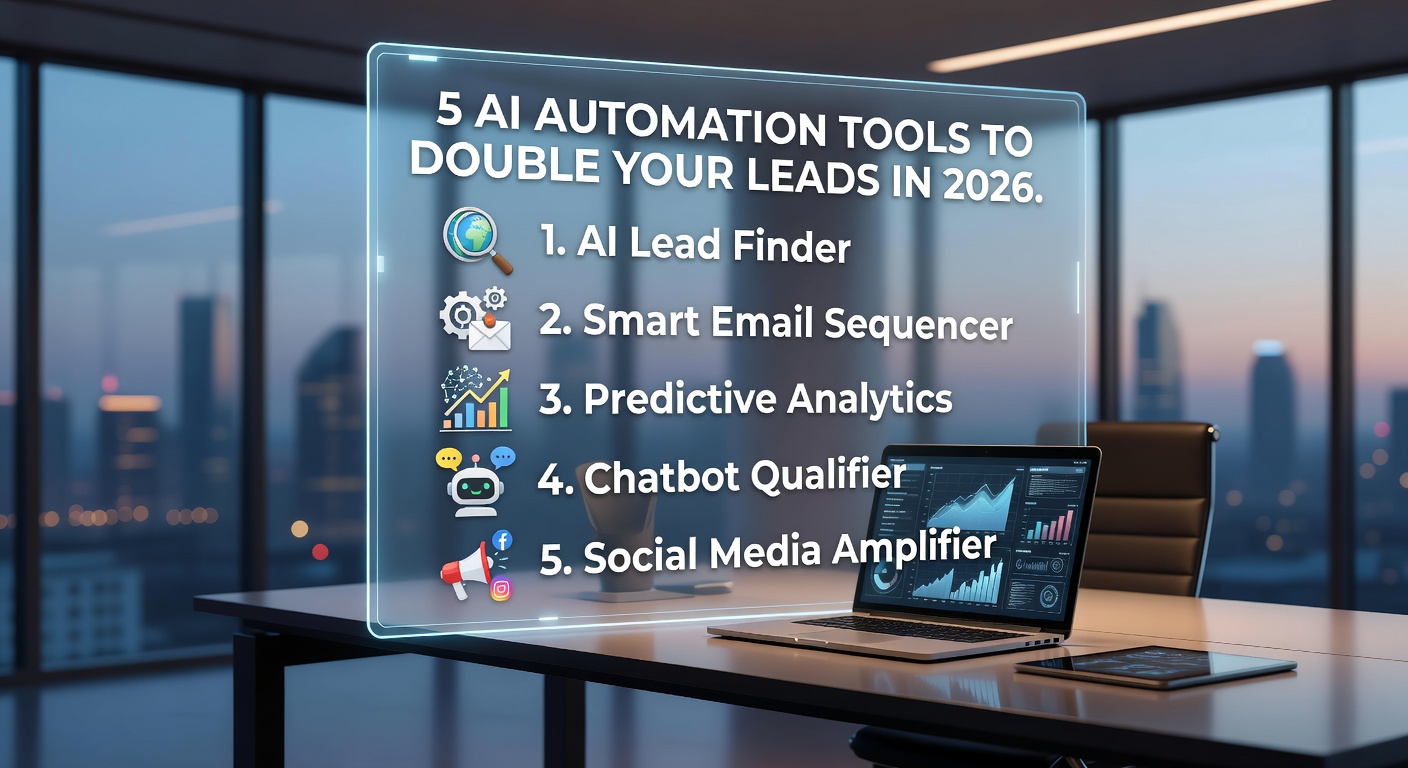
5 AI Automation Tools to Double Your Leads in 2026
AI automation tools for leads aren’t magic. They’re multipliers: they take a lead generation process that already works and make it faster, more consistent, and more scalable. If your current process isn’t generating leads, AI automation tools won’t fix the underlying issue — they’ll just automate the failure.
But if you have a working process — some traffic, some conversions, some outreach that occasionally lands — the right AI automation tools for leads in 2026 can reliably 2x your output without 2x the effort.
Here are the five tools that deliver the highest ROI on lead generation automation.
How AI Changes Lead Generation in 2026
AI automation tools for lead generation in 2026 operate across three distinct stages of the acquisition funnel: attraction (using AI to identify and reach target prospects), conversion (using AI to qualify, respond to, and route incoming leads), and follow-up (using AI-enhanced sequences to nurture prospects without manual effort). The key advancement over 2024 is the integration of large language models into automation workflows — allowing platforms like Make, Zapier, and Clay to incorporate AI analysis steps (classification, personalization, summarization) as native workflow nodes alongside traditional data-transfer operations. This means automation workflows can now make judgment-based decisions — classifying a lead as high or low priority, personalizing outreach based on company context, or summarizing a long email thread for a sales rep — without human review at each step. Companies implementing AI-enhanced lead generation automation report 40–70% increases in qualified lead volume within 90 days of full deployment.
The key shift: AI automation tools for leads in 2026 don’t just move data — they add intelligence to the workflow. A Zap that triggers when someone fills a form is automation. A workflow that analyzes the form response, scores the lead, personalizes the follow-up, and routes to the right team member based on company size is AI automation.
Tool 1: Clay — AI-Powered Lead Research and Outreach
What it does: Clay connects to 50+ data providers (LinkedIn, Clearbit, Hunter, Apollo) and uses AI to research prospects and write personalized outreach at scale.
Why it works for leads: The biggest problem with outbound is personalization at volume. Writing genuinely personalized emails takes time. Clay pulls company data, recent news, LinkedIn activity, and job postings for each prospect — then uses Claude or GPT to write personalized first lines for each email automatically.
The workflow: 1. Upload a list of target companies (or build one using Clay’s filters) 2. Clay enriches each company with data from its connected providers 3. AI analyzes the data and writes a personalized opening line 4. Completed emails export to your email tool for sending
Time saved: 2–3 minutes per personalized email. At 100 prospects/week: 3–5 hours saved weekly.
Pricing: From $149/month. Worth it if you’re doing any outbound at volume.
Best for: B2B companies running outbound email campaigns.
Tool 2: Make (with AI Steps) — Lead Routing and Qualification
What it does: Make is a visual automation platform that can include AI steps — meaning you can build workflows that analyze incoming leads, classify them, and route them appropriately.
Why it works for leads: Most businesses receive mixed-quality leads. Someone fills a form — are they a good fit? An AI step in Make can answer that before a human reviews.
The workflow: 1. Trigger: new form submission 2. Make sends the form data to ChatGPT or Claude via API 3. AI returns: lead score (1–10), primary interest, urgency level, recommended next step 4. Based on score: high-scoring leads route to CRM with “Priority” tag; low-scoring leads go to nurture sequence; spam gets filtered
What this eliminates: A sales rep manually reviewing every form submission to decide what to do with it. The AI does the triage; the rep handles only qualified leads.
Time saved: 1–2 hours/week for a team handling 50+ leads/week.
Pricing: Free (1,000 operations/month), from $9/month.
Best for: Teams receiving a mix of lead quality who need intelligent routing.
Tool 3: Apollo.io — Intent-Based Lead Identification
What it does: Apollo is a B2B database and outreach platform with AI-powered lead scoring based on intent signals — identifying prospects who are actively researching solutions like yours.
Why it works: Instead of cold-targeting everyone who fits your ideal customer profile, Apollo’s intent data identifies companies where buying signals are active: they’ve been researching competitor products, recently hired in relevant roles, or are publishing content about challenges your product solves.
The workflow: 1. Define your ICP (industry, company size, role, location) 2. Apply intent filters (researching [your category], [your competitors]) 3. Apollo returns a list of qualified, signal-positive prospects 4. Export to your outreach tool or use Apollo’s built-in email sequence feature
What changes: Your outbound hits prospects when they’re already in buying mode, not at random. Response rates improve because timing improves.
Pricing: Free (limited), from $49/month for intent data.
Best for: B2B businesses with defined ICPs doing outbound prospecting.
Tool 4: HubSpot (with AI Features) — Lead Nurturing and Scoring
What it does: HubSpot’s CRM now includes AI-powered lead scoring, conversation intelligence, and predictive analytics. It identifies which leads are most likely to convert based on behavioral signals — pages visited, emails opened, content downloaded, time on site.
Why it works for leads: Most CRMs are passive databases. HubSpot’s AI scoring actively surfaces which contacts in your database are showing buying signals right now, so your team focuses attention on the right people at the right time.
Key AI features: – Predictive lead scoring: assigns probability-to-close based on behavioral and demographic data – AI-generated email subject lines and CTAs based on contact preferences – Conversation intelligence: transcribes and analyzes sales calls for coaching – Chatbot: qualifies website visitors and books discovery calls automatically
The workflow for existing databases: 1. AI scoring surfaces high-probability contacts weekly 2. Sales team works the high-priority list 3. Mid-priority contacts enter AI-personalized email sequences 4. Chatbot handles website leads in real-time
Pricing: Free CRM (limited AI). Professional plan (includes AI scoring) from $800/month.
Best for: Growing B2B teams with existing contact databases.
Tool 5: Instantly.ai — AI-Enhanced Email Outreach at Volume
What it does: Instantly manages email infrastructure and AI-personalized outreach sequences at scale — rotating across multiple email accounts to avoid spam filters, warming up inboxes automatically, and using AI to vary subject lines and body copy for deliverability.
Why it works: Email volume outreach has two enemies: spam filters (triggered by repetitive sending patterns) and generic content (triggered by recipients not opening or clicking). Instantly solves both: its infrastructure rotates sending patterns to stay out of spam, and its AI generates content variations to improve engagement metrics.
The workflow: 1. Build or upload your prospect list 2. Write your email framework (intent, value proposition, CTA) 3. AI generates variations of each element 4. Instantly manages sending across your email accounts 5. Positive replies route to your CRM for follow-up
Time saved: Building and managing an outbound email system manually takes 5–10 hours/week for someone with no automation. Instantly reduces active management to 30–60 minutes/week.
Pricing: From $37/month for 1,000 active contacts.
Best for: Businesses doing outbound email to cold prospects at volume.
How to Combine These Tools
The highest-performing AI automation tools for leads in 2026 work in concert:
Inbound + AI Qualification: – HubSpot collects and scores inbound leads – Make routes based on score to CRM or nurture sequence – High scores trigger personalized follow-up via ConvertKit
Outbound + AI Personalization: – Apollo identifies intent-positive prospects – Clay enriches and personalizes each contact – Instantly manages delivery and tracking – Replies import to HubSpot for CRM management
You don’t need all five tools at once. Start with the one that addresses your current bottleneck:
| Bottleneck | Start with |
|---|---|
| Not finding the right prospects | Apollo |
| Finding prospects but low response rates | Clay or Instantly |
| Getting leads but losing them in follow-up | HubSpot or Make |
| No time to manage the process | Make (routing automation) |
FAQ
How much do AI automation tools for leads cost? Starting costs: Apollo free tier, Make free tier, Instantly from $37/month. A full stack (Apollo + Clay + Instantly) for serious outbound: $300–500/month. Budget accordingly based on lead value.
How long before you see results? Intent-based outbound via Apollo typically shows results in 2–4 weeks. Email infrastructure warming (Instantly) takes 3–4 weeks before full volume. HubSpot AI scoring improves over time as it learns from your data.
Are these tools too complex for a solo operator? Apollo and Instantly are designed for solo operators. Clay has a learning curve but solid documentation. Make requires more investment but handles complex workflows. HubSpot at scale is better for teams.
Key Takeaways
The best AI automation tools for leads in 2026:
1. Clay — AI personalization for outbound at scale 2. Make — Intelligent lead routing and qualification 3. Apollo — Intent-based prospect identification 4. HubSpot — AI-powered lead scoring and nurture 5. Instantly — Email infrastructure for high-volume outbound
Start with one tool that addresses your biggest bottleneck — then layer in the others as your process matures.
For more on building automated lead systems, read our build automation without coding guide and our marketing automation for freelancers guide.
Last updated: May 2026.